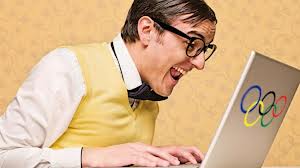
Is Web 2.0 Only for Geeks?

I’ve been thinking and posting about all these new Web 2.0 applications a lot lately. There’s no doubt that there are some great applications our there, most of them free, that can greatly enhance, simplify and organize our lives.

But here’s what starting to bug me: does anyone other than us know about them? Is Web 2.0 about everyone, or just the geeks (like me) who follow technology closely?

I can’t even get my friends and family to use Flickr, so how am I going to get them to use any of these things?

After I posted my mini-review of the best of the Web 2.0 applications, I asked some of my non-geek friends if they saw the post. Many of them said yes. But when I asked what they thought, they almost universally said that they didn’t really understand what all those programs did, and that they didn’t have the time (they meant inclination, but were being gentle) to try to figure it out.

There’s an obvious and substantial payoff to learning how to use Flickr. Our jobs require us to use email and Word. But the payoff for a lot of these Web 2.0 applications is more subtle, more remote. If Flickr is on the wrong side of the effort line, where does that leave these other applications?

So I wonder if the rest of the population really cares about Web 2.0? Is it enough that the technorati follows the development of these applications and eagerly uses them? I bet even the technorati’s use of many of these applications tapers off over time. I love to try out these new applications, but maybe one in ten becomes a part of my core application list (Flickr, Del.icio.us and Technorati being the big three so far).

Maybe over time all this stuff will be second nature to all the moms, dads, students and teachers. But we aren’t there yet (by a long shot) and it seems to me it will take some time to get there.

What does this mean for Web 2.0?

Will it change the world or is it just a passing fad of the technorati?

  • Share/Bookmark

Tags:

  • "Web 2.0" applications that actually deliver real value to real people (not just geeks like us) will become part of folks' regular Internet use. They probably won't think about them as something grand like "Web 2.0" (said in deeper tone). They'll just think, oh here's a cool way to share pictures with Uncle Joe. The whole construct of "Web 2.0" as a discrete thing? That belongs to the tech-aware/bleeding edge. Which is one of the reason I think it is a bit BS. I don't much care how cool technology is, I want to understand real user value. And it would help if it really WERE easy to use. A lot of this stuff still isn't, and I'm not sure the developers actually realize this:-)
  • There was a can't missing. Thanks for the heads up.

    I'll add my thoughts on all these great comments later tonight when I get home.

    Thanks,
    Kent


  • I even get my friends and family to use Flickr, so how am I going to get them to use any of these things?

    Hate to nitpick, but I'm thinking there is a "can't" missing in there.

    More on topic: Every once in awhile I will try to use the term "Web 2.0" in run of the mill conversation, which results in the kinds of looks normally reserved for "any of you know how to play Cricket?" (Asked of lifelong Texans.) I'm thinking that the hype is firmly ensconced in a bubble. A lucrative one, if you can swing it, but a bubble.


  • Your blog was the first place I ever heard the phrase "Web 2.0". I would argue that it's not a major "new release" of the Web... just another gradual evolution... so the term is a bit misleading.

    Which is why non-geeks aren't quite so obsessed about these things. Over time they will start using one or two of the things you describe as "web 2.0". Does this mean they have "upgraded" to a better web? Well yes, using it may be better, but it's not really a new product... still the same old Web, but with some new innovation here and there.

    So I don't really see what all the fuss is about. And if your mother-in-law starts to think that "web 2.0" is something completely different and new and difficult to use, she'll be even less likely to want to learn to use Flickr...


  • I think that we're just the leading edge and others will follow in their time. The Web itself was once for the technorati alone. Blogging and podcasting are in the process of crossing over to the masses. Sooner or later AOL will start giving mashups to their users or something, and it'll take off. Give it time.
  • In Crossing the Chasm Moore explains that all technologies must start with the technical elite or what you call technorati, and must pass the chasm to spread to the rest of the market. I don't believe that web 2.0 will be any different. After all the internet had to cross the chasm, and so did broadband, and so will these types of social sites. I find that if something is truly interesting, and offers a real benefit to consumers that the product or service that the users are exited about and eager to communicate, will naturally cross the chasm over time. Some web 2.0 sites will fail, and have no chance of crossing the chasm into the mainstream while others will no doubt live on. My bet is that as the early users embrace and continue to use the sites over time the majority will begin to use them as well. Being the founder of Seekum (a social search engine) these thoughts give me focus. Everyday I must continue to build something that our users will truly love, and continue to use over time.
blog comments powered by Disqus