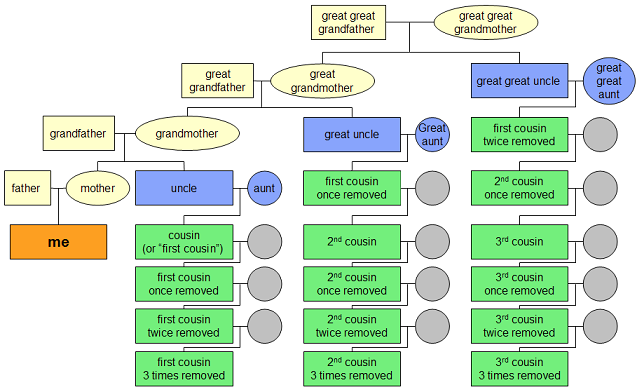
Cousins Removed

At dinner the other night, we were trying to figure out what a cousin once removed is. Nobody was even close.

I don’t understand how my cousin’s child and my great uncle’s child can both be my first cousin once removed.  Someone want to dumb this down for me?

(via Rob Gale)

Technorati tags: ,
  • Share/Bookmark
  • I see this has been figured out already, but I "did the math" :P ...

    I'm not a geneticist but looking at the logic of the problem I think the intuition is difficult because the chart, for the purposes of looking at one's own relationship within it, is upside down or wrongly topped. "ME" should be at the top.

    If you look at the chart in terms of a gene portion of "ME" then each time you cross a mating branch you cut the "ME" gene portion in half. If you travel along a brother-sister line you make no changes. That is, for the purposes of this approach, you and your brother or sister are equivalent - from the same gene pool of mother and father.

    Looking at the "cousin's child" situation and using this approach, going from "ME" to mother-father means your mother has only 0.5 of "ME" (derived from the maternal grandparents). But since there is a brother-sister equivalence, this 0.5 "ME" is the same for your uncle (your mother's brother). Traveling down the tree from your uncle to your cousin you go across a mating branch and split the "ME" gene portion in half (multiply by 0.5). This gives a 0.25 "ME" value for your first cousin. Going further down from your first cousin across a mating branch to your first cousin, once removed gives 0.125 "ME."

    Stepwise for "cousin's child" -

    Father-Mother (mating) : multiply by 0.5 -> 0.5 "ME"
    Mother-Uncle (no mating) : multiply by 1 -> 0.5 "ME"
    Uncle-Aunt (mating) : multiply by 0.5 -> 0.25 "ME"
    1stCousin-Mate (mating) : multiply by 0.5 -> 0.125 "ME"

    ["Cousin's Child = first cousin, once removed or 0.125 "ME"]

    ..........

    Now check for your great uncle's child.

    Father-Mother (mating) : multiply by 0.5 -> 0.5 "ME"
    GFather-GMother (mating) : multiply by 0.5 -> 0.25 "ME"
    GMother-GUncle (no mating) : multiply by 1 -> 0.25 "ME"
    GUncle-GAunt (mating) : multiply by 0.5 -> 0.125 "ME"

    ["Great Uncle's Child" = first cousin, once removed or 0.125 "ME"]

    ..........

    Note that in the "cousin's child" situation the common gene portion is the maternal grandparent combination (mother, uncle equivalent). A "first cousin, once removed" has this split by two generations giving only a quarter of the common grandparent gene portion. But that common portion is only half of the "ME" genes, so the relation is further split down to one eighth.

    For the "great uncle's child" the common gene portion is the maternal great grandparents. A "great uncle" represents that gene portion completely and his child has one half of it. But the maternal great grandparents, being two generations distance back from "ME" represent only one quarter of the gene portion of "ME." The "great uncle's child's" one half relation to that one quarter means only a one eighth gene portion in common with "ME."


  • That makes sense, when I look at it from the perspective of the "other cousin." But starting from the "me" in that chart, it seems odd.

    But I think you're right.

    For some reason this reminds me of the Monty Hall Paradox.


  • I think it's easier to imagine if you think about the relation being "cousin once removed" than the person on the other side of the relation being "cousin once removed".

    From what I read, the idea is to keep both ends of the relationship named the same. Your cousin's child's relation to you is that you are his great uncle's child. So that relation has the same name (which is different from "father/son" and more like "friends").

blog comments powered by Disqus