Archive | How to RSS feed for this section

How to Create a Life Stream Page on Your Blog, With Posterous

We’re really rocking the blog development lately.  Yesterday, I showed you how to point a domain to one of your blog categories.

Today, we’re going to create a life stream page, on your blog, using Posterous.

You can use the life stream page we’re about to create for just about anything.  You could send all of your life stream content there, autopost it to Twitter, Facebook, etc. and end up with a great, chronological and searchable archive of all of your content.  I have Twitter already integrated into Newsome.Org, via the widget in the right hand column, so I’m going to do something a little different.

I want to create a page where I can automatically upload and share impromptu iPhone photos, and maybe some other tidbits from time to time.  Notwithstanding the limited chops of the iPhone camera, I find a lot of iPhone photos really compelling, partially because of those limitations.  Plus I almost always have my iPhone with me.

image

But, as part of my ongoing content consolidation and simplification project, I want my iPhone photo stream to be available here, as a Page.

Let’s get started.

Get a a Posterous Page

If you don’t already have a Posterous page, go sign up.  Learn how to use it- it’s about as easy as it could possibly be.  Theme your Posterous page to have the same look and feel as your blog.  You’ll probably have to start with a canned theme and then customize it to your liking.

image

Make a Content Plan

Next, decide how you’re going to use your life stream page.  Posterous makes it really easy to autopost content to the social networks and other sites.  With a little work you can make Posterous your content hub and control panel.

Get Any Ancillary Apps You’ll Need

As noted, I want to use my page primarily as a place to upload and share impromptu iPhone photos.  A great way to do this is via the iPhone app PicPosterous (iTunes link).  It will make sharing iPhone photos via Posterous easy and almost completely automated.

I’m not crazy about the way it forces you do use albums, but it works OK.  I do like the fact that photos from each album are posted together.  I’ll just do an album for each day.  That seems burdensome, but it’s not really.  You’d need to name the photo anyway, and this means you only have to name the first one (e.g., 02/28/10) you post each day.  Any others can be sent directly to that album.

Embed into a Blog Page with an iFrame

Now to embed the Posterous page you have crated into your blog via an iFrame.

In WordPress

I use WordPress.  Here’s how you do it with my theme.  The process may differ slightly from theme to theme, but the basic concepts should be the same.

Create a new Page, and name it.  I called mine iStream.

If you have columns on your main blog pages, you’ll probably need to use a full width template for this page.  Many WordPress themes have this option for Pages.  If yours doesn’t, you’ll have to create a Page template.  Or change themes.

Add the iFrame code.  Here’s mine:

image

In Blogger

If you use Blogger, simply create a new Page, via Posting>Edit Pages>New Page, and include the iFrame code.  Be sure to select the Edit HTML tab first.

I don’t know that many, if any, Blogger templates have full width templates available for Pages.  If not, the resulting life stream Page may require horizontal scrolling, which is not good.  If I find (or someone provides in a comment) a solution for this, I’ll add it here.

The best bet if you really want a life stream page in Blogger might be to select a wide, one or two column template.

Add the New Page to Your Page Navigation

Once I created my new Page, I added it under the Media tab at the top of the Newsome.Org blog pages.

That’s all there is to it.  Looks great.  Easy to use.  Consolidated.

I like it.

Brother, Can You Spare a Word?

I’m working hard so you don’t have to.  If you like what I’m doing here at Newsome.Org, please spread the word via Retweets and links.

  • Share/Bookmark
Read full storyView Comments

How to Point a Domain to a Blog Category

One of my long-time and oft-stated problems with all of the so-called social networks is the brand and attention dilution that occurs when content producers cast their content across numerous networks, sending readers on a wild goose chase as they try to keep up with everything.  While I’ve done a lot better than most when it comes to keeping my content centered around my web site (Newsome.Org), I too have been lured into spreading myself too thin, network-wise.

I’m going to fix that.  I am in the process of consolidating most of my content and much of my applications.  When all is said and done, I will be a power user of this blog and a small number of ancillary networks (maybe as few as two: Twitter and Facebook).  Additionally, I intend to shrink my cloud toolbox down to a manageable size.  More on that later.

Today I want to take the first step, which is to consolidate our music recommendation blog, which was previously hosted at Tumblr, into Newsome.Org.  Specifically, I want that content to be included here- under the Music category.  But I want to continue to use the cool and valuable top level domain (GoodSongs.Com) that I have been using for song recommendations.

Here’s how that can be done.

What You’ll Need

To have this need and to make this work, you’ll need a blog platform that includes categories, tags or some other naming convention that has a URL.  I use WordPress, and I have a Music category (see the menu at the top of the page).  The URL for that category is http://www.newsome.org/category/music.

You’ll also need a domain (or a sub-domain) separate from the one that you use for your blog, that you want to point to the category.  As noted above, I am going to cause GoodSongs.Com, which previously pointed to a custom domain at Tumblr, to be redirected to my Music category here.

Use a Redirect

One way to redirect a domain to a blog category is through URL redirection  or a refresh meta tag.  A redirection makes sense if you have a long-standing or popular site that you want to move, so you can preserve links and Google juice.  If you, like me, just want to use your domain as an alternate address for a blog category- or if you don’t have the technical chops or server access to do a redirection, web forwarding might be your solution.

Configure Web Forwarding

I use Network Solutions as my primary domain registrar.  Here’s how you configure your domain for web forwarding via Network Solutions.  The process is probably similar at other registrars, but you may need to explore the configuration dashboard and maybe the help files to find the right pages and settings.

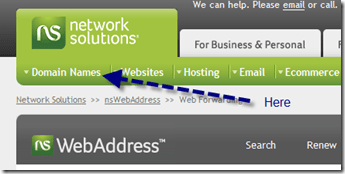
From your primary Dashboard, select the Web Forwarding option.  At Network Solutions, it’s under the Domain Names tab at the top of the page.

image

From the resulting page, select the domain you want to forward, then click on “Continue with Web Forwarding.”

image

On the next screen, fill in the URL of the category in the blank.  Web masking won’t work if your URL is a directory or database, but that’s OK.  The purpose is to get the readers to the new location at the blog category page.  You can brand the forwarded domain from within the category.

It Might Cost a Little

I don’t know what other registrars charge for web forwarding.  Network Solutions charges $12.00 a year.  A buck a month doesn’t seem too bad for a little consolidation.  Particularly consolidation that can be accomplished (or changed) via a few clicks on a web page.  Simple is good.

Don’t Forget to Feed Your Feed

If you have an RSS feed at the domain you are forwarding to the blog category, don’t forget to update the feed once you make this change.

In my case, I already had an RSS feed for GoodSongs.Com, which I publish via Feedburner.  My WordPress theme creates a feed for each category, so all I had to do was change my feed location for GoodSongs.Com to the category feed.

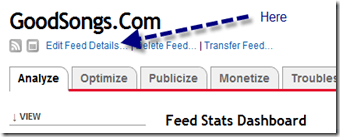
From the main Feedburner dashboard for the applicable feed, select Edit Feed Details.

 image

Then replace the current “Original Feed” with your new one.

image

That’s It

Once you’ve taken those simple steps, your domain will be forwarded to the blog category you selected.  Notice how GoodSongs.Com now points to the Music category here at Newsome.Org.

That’s step one in my consolidation and simplification process.  Stay tuned for more.

  • Share/Bookmark
Read full storyView Comments

How to Set Up Email Subscriptions for Your Blog

image There are a lot of nerds out there- like me for example- who think that RSS and feed readers are the only way online information should be consumed.  We feel bad about being nerds, until we remember there is a whole class of uber-nerds, who think that not only information,  but every part of life, is derived from Twitter.  Or, God forbid, via Google Buzz(kill).  Just kidding, both of those guys are smart dudes and friends of mine, in addition to being uber-nerds.
But enough about those so-called social networks.

Because today I want to show you how to do a subscription service that someone with tan lines might actually use.  An email subscription.  You remember email, right?  That service that millions of people who either (a) have never heard of or (b) laugh hysterically at those who use Twitter use every day.  All day.

So let’s assume that (1) you’ve been outside in the past 48 hours and (2) you’d like to put together an email subscription service for your blog.

Step 1: Pick a Service

If you use Feedburner for your RSS feed, this is pretty easy.  Use Feedburner.  The other major choice is Feedblitz.  I used Feedblitz for a while, but its navigation structure makes Facebook’s byzantine navigation system seem downright GPS-like.  Plus, Feedblitz wants you to to (cover your ears webkidz) pay for its premium service.  So as a part of my forced march to WordPress and Blogger Custom Domains, I decided to take my email party back to Feedburner.

Step 2: Configuring Feedburner

Here’s how to configure your Feedburner account to permit and manage email subscriptions.

From your Feedburner dashboard, click on Publicize and then Email subscriptions.

image

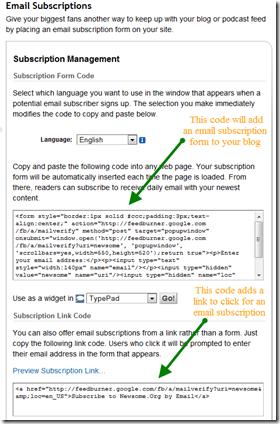
From the Subscription Management page, you can get code to embed a form or a link on your blog.  You can also enable a notification feature that will inform you when someone unsubscribes.  I wish Twitter had that feature.

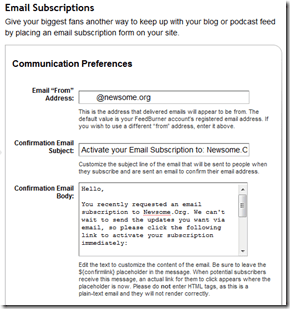
Next, go to the Communications Preferences page.  From here, you can set up your email address and the subject line and message for your email confirmations.

image

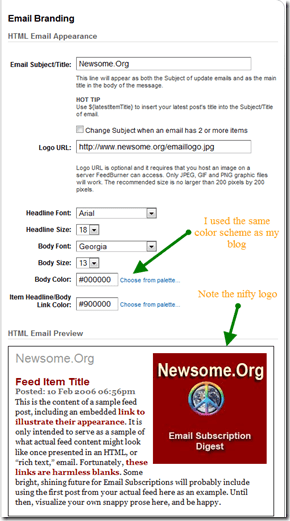
The next stop is the Email Branding page.  Here’s where you can really customize the look and feel of your emails.  You want the email to have the same branding, look and feel as your blog.  Note that you can create and upload a custom logo that will appear in your emails.

image

Finally, you can set your time zone and preferred delivery time via the Delivery Options page.

Step 3: Displaying the Subscription Option on Your Blog

Once you have configured your email subscription service, you’ll need to make potential subscribers aware of it.  Many WordPress themes and Blogger templates are pre-configured to display email subscription information.  See the top of this blog (WordPress) or Err Bear Music (Blogger) for examples.

image

Even if your theme or template doesn’t come pre-configured, you can easily add a subscription form or link, by adding the code that Feedburner provides on the Subscription Management page.

In addition to displaying the option on your blog, you should consider adding a link to your email signature, as those who would be most interested in an email subscription may not visit your blog, but do use and see email.

Step 4: Post as Normal and Let the Service Do the Work

After setting up your service and displaying a subscription form or link, your email subscribers will receive one email each day containing your blog posts for that day.

Here is a sample, from one of my recent subscription emails.

image

Step 5: While You’re Thinking About It, Subscribe to Newsome.Org Via Email

By clicking here.

That’s it.  Let the emailing begin!

  • Share/Bookmark
Read full storyView Comments

Record LPs to CDs Without a Computer

As most of you know, I’m a big music fan, having bought records, 8-tracks, cassettes, CDs and MP3s pretty much non-stop since I bought my first LP (Glen Campbell) back in the mid-sixties, and having been a songwriter and (starving) musician for years.

The combination of music and evolving technology means I often find myself with some great records on outdated media.  Generally, this means great LPs that aren’t available on CD or MP3.  I’ve converted quite a few records, and did a tutorial that remains one of my most viewed posts.

The approach I describe in that tutorial is as workable today as it was the day I wrote it.  But recently I decided to try another approach.  I wanted to bypass the computer altogether, and record directly from LP to CD.  Then, and only then, do I want to move or rip the songs to my MP3 library.

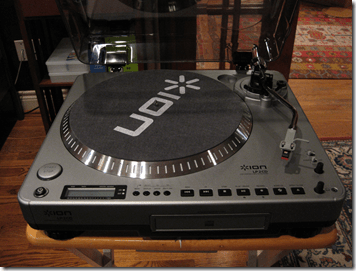
The tool I chose to do this is an Ion LP2CD turntable.  This is one versatile turntable.  It will connect to your receiver or your computer (via USB), and it has a built-in CD burner that will burn the LP directly to CD.  Or, actually, to its internal flash drive, and then to a CD.  This intermediate step is a good thing, since you can trim the song files, correct any glitches in the automatic song splitting and even reorder the songs, before you burn the CD.

Sweet, huh?

Unboxing

image

The turntable is fairly compact for one that includes a built-in CD burner.  I was able to put it together without reading the instructions.  Two hints: look closely for all the small pieces (the 45 insert, the counter weight for the arm, the needle, etc.), which come taped to various parts of the packing styrofoam; and don’t forget to pull the rubber drive belt around the spindle (see page 5 of the Quickstart Guide).  It took me less than 5 minutes to get the turntable put together,  plugged in and ready to rock and roll.

Picking a Test Record

image

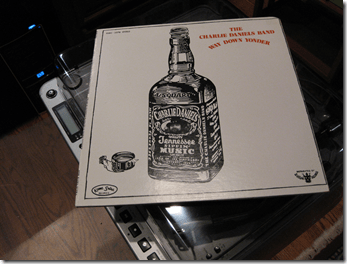
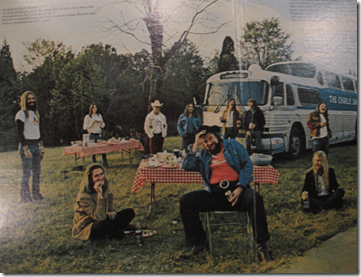
One the the best records you’ve never heard is The Charlie Daniels Band’s 1974 record, Way Down Yonder.  This is pre-Devil Went Down to Georgia Charlie Daniels, and sounds much more like the Allman Brothers or good, early and bluesy Elvin Bishop, than later era Charlie.  Sadly, it’s not available on CD or MP3.  But I have the record, and decided to use it to test the turntable.

Recording

The turntable has a handy headphone jack, so you can hear what you’re doing.

To record an album, put it on the turntable, play it a bit to get the sound levels right.  There’s a recording level knob and a level indicator on the led screen.

image

Once you’re ready, put the turntable in “INT” mode (internal flash drive), put the needle where you want to start, press Record button (the red light will come on), press the Play/Pause button, and then immediately the Start/Stop button, to begin the recording.  The turntable will attempt to automatically split the tracks based on gaps.  It does a good job, unless the record has a fair amount of scratches.  Fear not, it’s easy to manually split tracks once you’ve finished the recording.

In my test, Side A, which had a few scratches, didn’t split perfectly, but Side B did.

Splitting and Trimming

After you’ve recorded the record onto the flash drive, you can split tracks by navigating via Fast Forward or Reverse to the desired place and pressing the Split button.  You can also easily split out and erase long silences between tracks, if necessary.

In sum, this process works very well.  It’s easy, and even fun.

Recording to CD

Once you’re ready, recording to a CD is as easy as putting a blank CD-R into the CD drive and pressing the Burn CD button.  It literally could not be any easier.

The Results

The CD sounds great.  Sure, you can hear the same scratches you hear when you play the LP, but the reproduction is excellent.  Ripping the CD to your MP3 library is quick and easy.

Here’s the excellent song Land of Opportunity, to hear for yourself.

My only wish would be that the device record to the CD in MP3 format.  It would be great to save a step and avoid having to rip the CD.

But It Ain’t Cheap

The biggest, and just about only, drawback to the LP2CD turntable is its price: $321 (at Amazon).  If you have one or two records to convert, it’s definitely not for you.  If you have- or would like to buy- a lot of hard to find LPs, it just might be your ticket.

It’s going to be mine.  Time to browse eBay for some classic vinyl.

image

The inside cover of this excellent record

  • Share/Bookmark
Read full storyView Comments

How to Vastly Improve Your Facebook Experience with Filters and Lists

The sheer number of friends I have, in the real world and on the internet, who use Facebook ultimately led me to capitulate and start using it a little.  I’m not a huge fan by any means, but I will admit that I enjoy seeing what my friends are up to.

But like every other social application, you have to work a little to keep the experience efficient and rewarding.

Filters Make Good News Feeds

The most useful Facebook feature I have ever stumbled across is the ability to filter out certain content.  This has allowed me to banish from my sight all things Farmville, as well as most other games and gift apps (you know, where someone sends you a hug, or whatnot).  If you want to filter something, hover over an entry, click the “Hide” button that appears and choose to hide the application.

image 

Presto, no more screen clutter.

Doing this vastly improved my Facebook experience.

If you later decide you can’t live without the content you have filtered out, go to the bottom of your Top News page (not your Most Recent page), and click on Edit Options.  From there you can add any exiles back to your news feed.

image

The Circle is Large

Another thing that can really enhance your Facebook experience is the use of lists.  Here’s how you make a list, why you should and what lists allow you to do.

I have a very eclectic group of Facebbook friends.  Some from my hometown (Cheraw, SC), some from college (Wake Forest), some from Texas, and some that I know through years of tech blogging.  There are a couple of things I’d like to be able to do.

1. Have the option to read content from only one group at a time.

2. Share some things with one group, but not others.

Make a List and Check it Twice

The first step is to create Friends lists.  Take the time to decide on the best way to divide your Friends.  I decided to divide my as follows: Cheraw, WFU, Texas and Tech.  I may add more later.

Start by clicking Friends on the left side of your Home page.

image

Then click the Create a List button near the top right of the next page.

image

Name your list, and click on the applicable photos to add your friends to that list.  Friends can be on multiple lists.  When you save it, the newly created list will appear under Friends in the left hand column, when you click on the Friends link.

image

Now, if you want to see content from only people on one of your lists, all you have to do is click on that list.

Quick Note: Deleting a Facebook List

Facebook has probably the most unintuitive terminology and navigation structure in the history of the world.  You can see above that I originally had a Personal list, which I decided not to use.  To delete a list, Click on Account (near the top right of the page) and select Edit Friends.  You’ll see your lists in the left hand column.  To delete a list, click on it and select Delete List at the top.

image

So that’s the way to set up lists that you can filter for content, and to delete ones you no longer want.

Protecting Your Info

Another thing lists allow you do do is decide what portions of your personal information and content can be seen by each group.  I haven’t done a lot of this yet, but here’s how you do it.

Click on Account and then Privacy Settings.  From here, you can customize the way lots of information is distributed.

image

Let’s say you want to control who can see your mobile phone number.  First, click on the Contact Information link.  Then click on the button beside Mobile Phone.

image

From the pop-up menu, click Customize.  In the box beside “These people” select Specific People.

image

From this page, you can elect to make this information available to only specific lists and/or to hide it from specific lists.

You Can Also Customize Posts

Once you have lists set up, you can also share content with only certain lists.  Let’s say I want to share an article about the Wake Forest basketball team’s latest clinic in under-achieving with only my WFU list.

After inserting and attaching the link, click on the lock icon near the bottom of the box.

image

Again, select Specific People in the box beside “These people,” and type the applicable list in the box.

image

This will share the link with people in my WFU list, but not with people in other lists, who didn’t go to Wake Forest and can be spared from the frustration that comes with being a Deacon fan.

It’s Hard, But Manageable

Facebook is burdened by a byzantine navigation structure that harkens back to its origins.  It is a lot harder to configure and navigate around Facebook that it ought to be.  But it can, and should, be done if you want to get as much out of Facebook as possible.

  • Share/Bookmark
Read full storyView Comments

How to Use the New Newsome.Org

OK, our migration to WordPress, which was documented here, is complete, and I am very happy with the results.  In sum, I think the new look and the new functionality rocks.

But, as a blog partially targeted to grownups who don’t necessarily live in Google Reader or on Facebook or Twitter, we have a lot of readers who consume our content the old fashioned way.  By coming to the web site and clicking around.

I’ve had a few questions, so here’s a rundown on how to use the new layout.

image

First, what hasn’t changed.  The newest content, across all Categories, is still located in the middle column, with the newest post at the top.  This has not changed- it was the same way in the prior layout.

Categories

But now, there are additional options, if you want to filter your content.  You can slice and dice content several ways.  First, by Category.  Note the horizontal menu between the red header and the gray line at the top of the page: Home, Tech, Music, Life, How to, etc.

Let’s say you want to read only our music content.  Click on that link in the top menu, and the center content will display only our music content, with the newest content at the top.  Same with Tech, Life and How to (our tech tutorials).  If you want to hear our podcasts, there’s the Podcast link.

Media, which has two sub-categories, is the place to go for photographs or videos.

Finally, there is an About page for those who want to know more about me and a Contact page, where you can send me an email or leave me a voice mail.

In sum, the default Home page has the same content as our old layout, but there are now topical options that display specific kinds of content.

More Ways to Find Good Stuff

Categories are great, but there are even more ways to drill down to the content you want.

See the box in the right hand column with tabs: Popular, Latest, Comments and Tags.  Popular shows the recent posts that have the most discussion (e.g., comments, reactions, etc.).  Latest shows a quick list of our latest posts.  Comments displays the most recent discussions that have occurred in comments to posts.  And finally, Tags are a clickable index where you can click on a topic and get only content about that topic.  If you are looking for something very specific, the Tags tab is the place to start.

You Can Read Content in a RSS Reader

Another option is to read our content in a feed reader, such as Google Reader.  We have our main RSS feed, which has the same form and content as always.  Additionally, there are Category-specific RSS feeds near the top of each Category page.

Or Via Email

If you’d rather avoid the whole web-business and don’t use a feed reader, there’s the option to have a single email delivered straight to your inbox every night, with all of our posts for that day included.  To subscribe by email, click here or on the link near the top of the page.

What About the Sidebars?

There are a lot of extra goodies in the two side columns.

On the left hand side, we have a Menu of Newsome.Org content; links to my pages on the various social networks and photo and video sites; links to our excellent, hand-crafted Pandora radio stations (take a listen, you’ll like them); and hand-picked music and book recommendations (which are linked  to Amazon, where you can buy and download them or have them mailed with just a couple of clicks).

On the right hand side is the tabbed content box described above; a search box, where you can search Newsome.Org and see what others have recently searched for (that list is also clickable); a list of my latest Twitter posts; and some of my Flickr photos (click for the larger versions).

That’s it.

We’ve made it easy to find the content you’re looking for.  Enjoy.  Leave us a comment and tell us what you think!

  • Share/Bookmark
Read full storyView Comments

How to Share Your Google Calendar

I’ve done a few hard things. Learned code. Built a computer from parts. Finished a Rubik’s Cube. Learned how to navigate around Facebook (sort of).  You get the picture.

But nothing prepared me for the chore that was configuring my Google Calendar to allow my secretary to see and add appointments.

So I thought I’d so a step by step to save someone a little agony.

I use Google Apps for my email and calendar, so there are a couple of extra steps that may not be required for regular Google Calendar users.

Step 1: Configure Sharing Rights (Google Apps Only)

This is where a lot of Google Apps users get tripped up.

To share your calendar with people outside your domain (in my case, those without @newsome.org email addresses), you must enable sharing with people outside your domain, within Google Apps.  From your Google Apps Dashboard, click on Calendar and then set the “Sharing options” for users "Outside this domain" to "Share all information, and outsiders can change calendars."  If you don’t do this, the person you are trying to share your calendar with will, at most, only be able to see if you are free or busy- no details and no ability to add items to your calendar.

image

Step 2: Wait a While (Google Apps Only)

Once you configure your Google Apps as described in Step 1, it takes a little while (maybe an hour) for your revised sharing settings to take effect.  This can be very frustrating to those who don’t know about this delay.

So be patient.  Go grab some lunch.

Step 3: Make Sure the Person Has a Google Account

In order to log-in and see your calendar, the person you want to share your calendar with must have a Google account.  This is not the same thing as a Gmail account.  Any email address can be used to create a Google account.  The sign up page is here.

Step 4: Grant Access via Your Calendar

Now go to your Google calendar.  Navigate to Settings>Calendars.  Look beside your calendar (the one you want to share, not someone else’s that is being shared with you) and click on "Shared: Edit Settings."  Add the person’s email address to the blank under “Share with specific people” and choose "Make changes to events."  Click on the "Add Person" button, and the entered email address should appear in the list below, with the correct sharing level.

image

If it still says "See only free/busy (hide details)," then you need to go back to Steps 1 and 2 above.  Probably it’s a matter of the delay described in Step 2.

Step 5: Log-in and Share Away

Then, once the person logs into his or her Google account, he or she will be able to access and add to your calendar.

That’s it.  Post any questions in the comments.

  • Share/Bookmark
Read full storyView Comments

More on Blogger Custom Domain Publishing

I’ve been spending a lot of time working on Newsome.Org’s move to WordPress, which is going remarkably well (more on that later).   But today I want to look a little deeper into the process and benefits of publishing your blog via a Blogger Custom Domain.

First, a recap.  Recall that Blogger has announced that it will discontinue publishing via FTP on March 26, 2010.  This caused a general panic here at Newsome.Org, followed by a somewhat more thoughtful election to move Newsome.Org to WordPress and my music publishing company (Errbear Music) to a Blogger Custom Domain.  As I noted before, the process was generally very easy.  Here’s the step-by-step walk-through of the process.

Here are some updates.

Adding Post Pages

When I was publishing to Errbear Music via FTP, I was hosting the blog files in a directory on my Newsome.Org server, and using a page in that directory (errbear.html) as the blog’s front page.  I  then parked the  errbear.com domain on that page, meaning that when someone directed their browser to errbear.com, he or she was forwarded to the errbear.html page.  It looked reasonably seamless.  The problem became that all of the post pages and other ancillary pages were located at Newsome.Org, and had a Newsome.Org URL.  Once I set up my Custom Domain, I wanted to have all of the post pages and ancillary pages located within that domain.  This happened automatically for the post pages, but could not happen automatically for the various ancillary pages located in that directory.  The majority of those ancillary pages were the very important lyrics and streaming mp3 pages for my songs.  This required me to create a new post page, containing the lyrics and a streaming mp3,  for each of my songs.  It wasn’t a soul-crushing task, using Live Writer and the time saving Text Template plugin, but it did take some time.

I want to be clear about something, to avoid confusion.  The pages I am talking about were not previous blog posts.  They were html files on my server that I linked to from the sidebar and in blog posts.  For those who wonder how things got that way- my Errbear Music pages pre-dated by years the advent of blogging and blogging software.  Those pages existed when I moved to a blogging platform.

A couple of pointers for anyone who has to do this:

1. Blogger allows you to mass edit labels.  This is a huge time-saver.  I decided about 2/3 of the way into the process to create genre-based labels.  It would have been soul-crushing to go back and add labels to each post page manually.

2. There is a limit to the number of posts you can make each day to a Blogger blog.  I don’t know the number, but it’s large.  I ran into the “too many posts”  error a couple of times when adding the post pages.  Wait a day and you can get back to uploading pages.

I would note that I decided to leave the mp3 song files on the Newsome.Org server.  The size of that song library and all the links out there (via a lot of the music search engines) led me to conclude that those files should be left where they are.

Templates are Themes

I wasn’t all that crazy about the default selection of templates.  Initially, I hacked up one of the default selections and made it work.  There are, however, a lot of good templates out there, you just have to look for them.  I started with the Natural Health theme, and went from there.  I think that template is as pretty as any WordPress themes I have seen.

It’s easy to upload a template via your Blogger Dashboard.  Simply find a template you like and then:

1.  Download the template to your computer.  If the template is contained in a zip file, extracted the XML template file.

2. Log in to your Blogger Dashboard and go to Template> Edit HTML.

3. Back up your old template in case you decide to use it again. Simply click on the “download full template” link and save the file to your hard drive, or just copy and paste the html to Notepad.

4. Look for the section near the top where you can browse for your XML template.

5. Enter the location of your template and click “upload”.

6. The html of your new template will now appear in the box below. You can preview your new template or save it and start using it right away.

Hacking the Template

Much of what you want to change can be done via the Layout editor within your blog settings.  Blogger has a “Gadget” approach, very similar to WordPress’s “Widgets.”  While there isn’t the developer community behind Blogger Gadgets like there is for WordPress plugins and Widgets, I am confident that you can do just about anything layout or content wise on a Blogger template that you can do in a WordPress theme.

At the end of the day, I found the manipulation of  Blogger templates to be a little less powerful and a little easier than WordPress themes.  It’s not the kiddie pool, by any means, but there is a rope to help you keep from drowning.

One tip:

While you can do a lot via the Layout editor, you’ll need to (and can) edit the html for some tweaks.  For example, until I went in and hacked the template code, my email subscription form was subscribing people to the email feed of the template developer.  For what it’s worth, I have been using Feedblitz for my email feed for years, but moved back to Feedburner for both my blogs today.  (If you don’t know what a Feedreader is and want to subscribe to Newsome.Org via email, click here)

At the end of the day, moving to a Blogger Custom Domain is very easy, and Blogger provides the tools to create just about anything you could want.  I’ll do a feature by feature comparison of Blogger and WordPress soon, but in the meantime, I can say that publishing to a Blogger Custom Domain is a fine, feature-rich option for your blog.

As always, I’ll try to answer any questions posed in the comments.

  • Share/Bookmark
Read full storyView Comments

How to Enable YouTube’s (Sort of) Parental Controls

My two oldest kids ( 11 and 8 ) are pretty intensive computer users, for both school and, to a lesser extent, fun.  They have a shared computer, here in my study.  Sometimes you can find them working away on their homework while I’m writing these exciting blog posts.

I use- and recommend- Windows Live Family Safety to control what they access on their computer.  It’s a good program, that does much of what I want it to do.  But there are holes to plug and redundancy is a good thing where my kids’ eyes and ears are concerned.

YouTube is one of their favorite web sites, and I have given access to it via Windows Live Family Safety.  But I want them to be able to see the things they should see there, without seeing the things they shouldn’t.  This has been a bit of a challenge, so I was happy to read today that YouTube has added parental controls.

If you want to control your or your kids’ YouTube experience, you can now do so via an opt-in feature known as Safety Mode (not to be confused with Safety Dance).

Let’s take a quick song break to dance around for a moment. . .

OK, back to YouTube.

The problem with YouTube’s implementation of these controls is that each YouTube user has to opt-in to Safety Mode separately.  Which means (from the FAQ):

Q: My kids and I each have separate profiles on our family computer. Do I have to log in to the same browser on each profile to lock strict filtering on each profile?
A:
Yes, each profile operates independently, so you would have to lock your preference on each browser on each separate profile.

There are a heap of problems with that, but I’ll pick three.  One, I have to log in to each of my kid’s computer accounts on every applicable computer (they have accounts on one of my laptops and the rarely-used Netbook), and enable Safety Mode.  Two, none of my kids have YouTube accounts, so I guess I log in as me from their computer account and enable this feature.  Three, it will take any kid who’s smart enough to use a computer about 30 seconds to disable this restriction.  Surely there’s an better way.

Let’s give it a try anyway.

After clicking over to YouTube and logging into my account, I see a recommendation of The Bangles doing one of the best songs ever.  Maybe it’s the fact that I’m hearing a great Big Star song without Alex Chilton, but, so far this feature seems a little half-baked.

So let’s take a better song break, shall we?

At the bottom of a YouTube page, you’ll see a link to enable Safety Mode.

 image

You can lock Safety Mode if you are signed into your account (from the FAQ):

Locked Safety Mode:

  • Sign In to your YouTube account
  • Click Safety Mode at the bottom of every page to open the preference setting
  • Click On and Save and Lock to opt-in and lock this browser
  • You are now in Locked Safety Mode!
    To opt out open preferences and Click Unlock Safety Mode.
    Enter your YouTube password to unlock Safety Mode.

This all seems like a lot of work to put a system in place on lots of accounts on lots of computers, which could be easily disabled.  I guess it’s better than nothing, but content filtering and parental controls could be addressed in a much more effective, easier way.

Note that Safety Mode is being rolled out gradually, so it may not be available to everyone yet.  In the meantime Read/WriteWeb has a detailed look at the feature, and its shortcomings.

  • Share/Bookmark
Read full storyView Comments

Windows Live Movie Maker: An Often Overlooked Gem

I, along with many others, constantly rave about Windows Live Writer.  It is probably my favorite current application.  I could easily give another sermon about it.

But not tonight.  Rather, I’m going to talk about Live Writer’s often-overlooked Microsoft Live Essentials suitemate: Windows Live Movie Maker.  It’s free, it’s relatively powerful, and it makes great videos.

I use it mostly for creating slideshows- a series of photos set to music.  Here’s how I made a pretty cool little video of some old photos of my parents and some of their friends.  In less than 10 minutes.

Step 1: Drag and Drop Photos

image

Open the application, click on the “Add videos and photos” button and drag and drop photos into the space on the right.  I grabbed photos from a folder in my Pictures Library called Old Prints.

image

Step 2: Add Music

Next, click on the “Add music” button, navigate to an MP3 you want to use and click on it.  I chose one of my favorite songs, Valse de Grand Pere, by the Bluerunners, from their excellent LP Honey Slides (purchase @ Amazon; Lala link).  The green band above the photos tells you there is audio associated with the movie project.

You’ll want to pick a song with a length consistent with the duration you want for each photograph.  For example, if you have 50 photos and you want each photo to be on-screen for 5 seconds, you’ll want a song that lasts around 4:10 (50×5=250; 250 seconds=4:10).

Step 3: Fit to Music

Next, click on the “Fit to music” button, which will automatically configure your movie length to equal the length of the song you added.

Step 4: Make Your Movie, Automatically

Next, click on the “AutoMovie” button, which will immediately and automatically add a title, cross-fade transitions between photos, and pan and zoom effects.

Step 5: Customize Your Titles

image

Click on the first and last slides, and replace the default text with the text of your choice.  You can add nifty text effects via the “Text Tools” tab.

Step 6: Choose Your Format

From the “Home” window, select your format via the “Sharing” box at the top.  I wanted an HD movie, so I clicked on the TV icon (which is the HD option), named my video file and, presto, an HD Windows media file is quickly rendered.

There is also an option to upload directly to YouTube or to burn a DVD.

Step 7: Upload and Enjoy

Old Prints from Kent Newsome on Vimeo.

That’s all there is to it.  Not a bad way to spend 10 minutes.

  • Share/Bookmark
Read full storyView Comments