
I like Robert Scoble. I really do. But, like my 8-year old, if I don’t watch him like a hawk he gets distracted and starts doing all kinds of crazy shit. Like pooping all over Google Reader, which is really a stand-in for RSS readers in general. I know he doesn’t really mean it. It’s like the time my 8-year old announced that she was giving up Skittles. It was a radical thought. There was logic to it. Shoot, it made me proud.
But it wasn’t real.
Two days later she was back in the grip of her Skittles addiction, insisting that no right-thinking person would choose a granola bar when those colorful, chewy, irresistible sugar pills were just sitting there on the shelf. Our battle over her junk food habit rages on, but I know in my heart that all the wishful thinking in the world won’t make a granola bar taste like a Skittle.
So let’s put Robert in virtual time out and see if we can get him to behave. One step at a time.
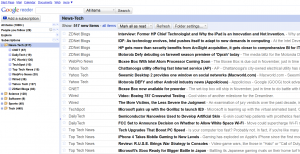
He says Google Reader is slow. I think that’s more of a problem with the front end platform that pushes the RSS feeds (e.g., FeedBurner), but I see his point. But as I have said over and over, Skittles are bad for you. Uh, I mean, faster is not always better. I simply don’t need to read about some dude’s latest Farm Game achievement or Mafia Wars battle in real time. And the flexibility of Google Reader (folders, the ability to rename feeds, archive feeds, search feeds, etc.) outweighs any marginal speed benefit you might get from the other sources (more on those below).
Of course, there’s a bigger flaw in that argument. Most Twitter posts are links to other content that got served by. . . RSS feeds or some other platform. The live on the scene Twitterer is the vast exception and not the rule. So even if Twitter is instantaneous, most of the information put on Twitter is not.
And while I’m debunking the speed canard, let’s be honest. When we thought that kid was in the balloon flying all over Colorado, we turned on CNN, not Google Reader and certainly not Twitter. For live important news, the internet just ain’t the place, and the difference between 5 minutes later and 15 minutes later just isn’t that big of a deal.
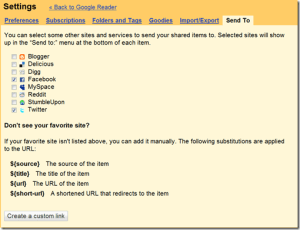
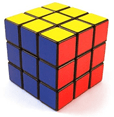 He says Google Reader’s UI is confusing. I agree that all that sharing stuff is unnecessary screen clutter. All we need to get our data out of Google Reader are the newish “Send to” buttons. But Google has gotten caught up in the sharing hysteria like everybody else. When all this sharing nonsense blows over, the internet will be a much more useful and fun place. But come on man, all you have to do is ignore all that crap, just like I do. And if you think Google Reader is confusing, then you must think Facebook is a big, non-intuitive mountain of Rubik’s Cubes.
He doesn’t like seeing all those unread items. I have a folder of traditional news feeds (CNN, USA Today, etc.) that fills up faster than a cheetah can run. You simply mark the entire folder as “read,” with one click. It’s not hard. Now trying to actually follow news topics on Twitter, that’s hard (more on that below).
Speaking of Twitter, does anyone really go to Twitter to consume content? Be honest. All I see are over there are people pushing unilateral content, like a flea market-cum-mailing list. And social? There’s more interaction on top of Mount Everest than there is on Twitter. Seriously, I get the sense that the Twitter hysteria among the general public is fading. If I owned Twitter, I’d sell it. Now, while there are still a lot of greater fools thrashing around with someone else’s money to spend.
He says the social network features suck. I would completely agree with this if it was an absolute statement, and not limited to Google Reader. They probably do suck in Google Reader, which is one of it’s strongest points. I don’t follow (or whatever the right word is) anyone via Google Reader. I just find my content there, and push it from there to my blog, Facebook page, etc. Let’s be honest, the social networks aren’t all that social, so why does a feed reader have to be social?
About this interaction business. If you want to interact online with real people, the fact is that there is only one place to do it- Facebook. The infrastructure is there. The developers are there. And most importantly, the non-nerds are there. The battle for the mind of the so-called social networker is over, and everyone but Facebook lost. Hell, I did everything I could to stay off of Facebook and I failed. Lots of my real world friends are there, and none of them are on any of these lesser services.
He says he sees most news faster on Twitter than in Google Reader. Uh, OK. That’s like saying I got to California faster on a horse than when I walked. The greatest myth in the history of the internet is that Twitter is the place to get news. First of all, you have to separate those who actually know the news and have the desire and ability to accurately describe it from the spammers and nut-jobs. Then you have to wade through the chaos and scrolling pages to find it. At least on the CNN and Google News pages, there is some semblance of an organizational structure that the nut-jobs must adhere to.
He says headline scanning is easier on Twitter. This is simply wrong. Robert, I challenge you to walk me through this and show me how it is easier on Twitter. If I’m wrong, I’ll eat my pocket protector. Hell, I’ll go one step further- it’s impossible to scan headlines on Twitter. Because there are none.
He says the iPhone apps are better for Twitter. I agree with that. Of course they are better, because Twitter has enjoyed a lot of momentum. Like Hanson did at one point, and the Jonas Brothers do now. Pretty soon all the kids will gravitate to the next big thing and Twitter will be relegated to the opening act. Like Isaac, Taylor and Zac.
The only question is who will get rich before that happens.
What do use to get your online content? And why?






 First of all, as a practical matter, RSS has never been alive. Ask anyone other than a hard core geek (like me) what


 I used the same basic header as the main Newsome.Org page, for the above reasons. I used a similar left sidebar, but with a few tweaks. I added a news-specific menu to the top, followed by the regular site-wide menu. I added a box to display my latest blog post (via Feed.Informer). I kept the Quote of the Day, Today in History and Today’s Birthday content, which is provided via scripts from


 The other day, I noticed that Feed.Informer had inserted a Feed.Informer logo and link at the bottom of each of my digests. Being very stingy with my web site real estate and deeply ad-averse, I visited the Feed.Informer web page in search of a way to get rid of this logo. What I found was interesting.
 have found it to be the best option for combining and displaying content, I have had a paid account for a long time. In fact, I thought I still had a paid account, and my account details at Feed.Informer confusingly indicate that I still have a premium account, though one that expired in April of last year. This confusion seems to result from Feed.Informer’s decision to eliminate premium accounts, seemingly in favor of paid support and, get this, paid logo removal.
 Newsome.Org